
When George LaComb transferred two years ago to a new high school in Orlando, Florida, the contrast was immediate. His previous school — less affluent, and across town — had none of the heat safety infrastructure he encountered at the new one.
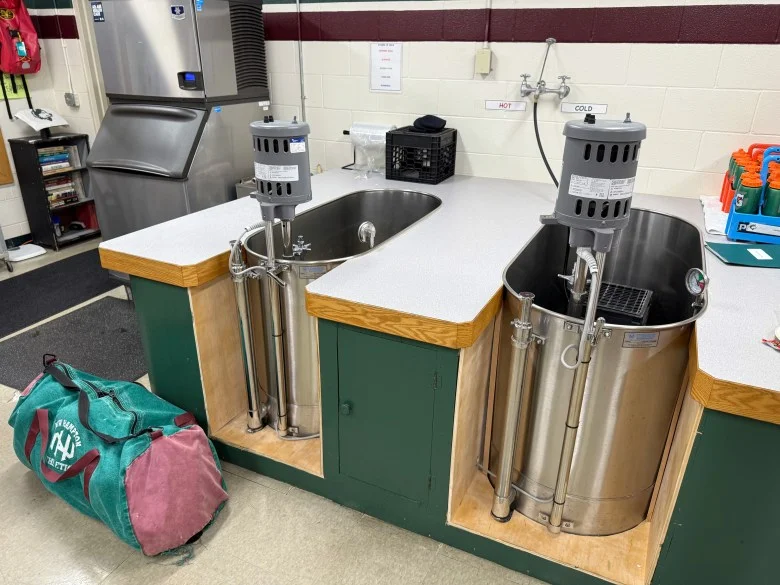
The new school had a dedicated recovery room staffed by a full-time athletic trainer, professional-grade ice baths for cooling overheated athletes, and indoor practice facilities for use when outdoor temperatures became dangerous. His former school made do with a single improvised ice bath and a cafeteria table for injured players.
"There's a vast difference between schools that have money and schools that don't," said LaComb, a senior at Lake Buena Vista High School and Florida state representative on the National Student Council, a membership organization for student leaders. "Making sure each school has the resources to keep students safe shouldn't be dependent on income."
As climate change drives temperatures to record levels, schools nationwide are confronting serious risks to student health — on athletic fields, playgrounds, and elsewhere. More than 9,000 high school athletes receive treatment for heat illness each year, according to estimates from the U.S. Centers for Disease Control and Prevention. In 2021, the most recent year for which data is available, nine high schoolers died from exertional heat stroke — a record high. At least 65 teenagers have died from heat-related causes since 2000, according to an analysis by the Louisville Courier Journal.
The United States currently has no national heat safety standard for schools. That could change once federal regulators finalize a workplace heat rule that would extend to school employees. In the meantime, states have been writing their own rules — requiring schools to adjust practice schedules, invest in professional-grade cooling equipment, and employ licensed athletic trainers capable of identifying and treating heat illness. But how well districts can comply, and whether they can move beyond the bare minimum to the kind of comprehensive protections LaComb found at his new school, comes down largely to money.
"The lack of funding and capacity in many places around the country will almost certainly lead to a continuation of the Swiss cheese heat health protections at the state and local level," said John Balbus, former deputy assistant secretary for climate change and health equity at the U.S. Department of Health and Human Services.
Related: Become a lifelong learner. Subscribe to our free weekly newsletter featuring the most important stories in education
The U.S. does not systematically track heat-related injuries or deaths in public schools. But recent research confirms exertional heat stroke as a leading — and preventable — cause of death in high school sports, with incidents rising over the past four decades. A potentially fatal emergency, heat stroke occurs when the body overheats and loses the ability to cool itself down, typically as a result of intense physical exertion or prolonged exposure to extreme heat.
Last July, a Mississippi high school sent 11 marching band members to the hospital after they collapsed during practice. That same month, a Memphis teenager died from heat stroke following football practice, and a 15-year-old in North Texas died in August after conditioning drills.
Children face distinct biological vulnerabilities to extreme heat. Their bodies acclimate more slowly to high temperatures and take longer to begin sweating effectively. They are more susceptible to dehydration, and younger children often lack the self-awareness to recognize when they need to cool down.
"Children spend more time active outdoors, which results in increased exposure to high ambient heat," said Autumn Burton, senior associate of climate, health and environment at the Federation of American Scientists. "Children usually depend on others to provide them with water and protect them from unsafe outdoor environments."
What has changed, she explained, is the intensity, duration, and geographic reach of heat events.
"Communities that didn't experience extreme heat in decades and years past are now facing it, and they don't have the infrastructure and planning and protocols in place to deal with it," Burton said.
The Korey Stringer Institute — named after the NFL player who died from exertional heat stroke during training camp in 2001 — advocates for athlete safety and grades states on their policies to protect young athletes, reviewing heat safety rules, athletic trainer licensing requirements, and coaching education standards. Since 2017, states have adopted nearly 200 heat illness prevention policies, said Rebecca Stearns, the institute's chief operating officer.
States like Florida and Georgia, where high-profile heat-related deaths have prompted legislative action in recent years, rank near the top of KSI's evaluations thanks to comprehensive regulations. Both states — along with Louisiana, New Hampshire, New Jersey, and North Carolina — received full marks for requiring athletes to acclimate at the start of formal practices, and for mandating protocol changes based on readings from wet-bulb globe thermometers. Experts consider those devices the gold standard for measuring heat stress because they account for air temperature, humidity, cloud cover, wind speed, and sun angle. All six states also require schools to maintain cold water immersion tubs on site at all warm-weather practices and to follow the "cool first, transport second" standard — lowering a person's core body temperature before transporting them to a hospital.
Colorado and Maine rank near the bottom of KSI's evaluation for lacking formal heat protections — a position California held until it passed new mandates in 2024.
Near the end of that year, the Biden administration advanced federal regulations that would, for the first time, require employers to protect workers from heat exposure — a category that includes teachers and other school staff. Employers would be required to develop heat hazard plans, with escalating protections triggered at higher temperature thresholds, such as access to cool drinking water and shaded rest breaks. Under President Donald Trump, the Occupational Safety and Health Administration is continuing to move toward finalizing those rules.
OSHA already requires employers to report heat-related deaths on the job — a reporting obligation that does not extend to student deaths at schools.
"At the high school level or below, there's no required reporting when a kid dies," Stearns said. "What we know is probably just the tip of the iceberg."
The new standards would also apply to only roughly half the country: Twenty-seven states, along with Puerto Rico and the U.S. Virgin Islands, extend OSHA protections to public-sector workplaces including schools. The remaining states do not cover government workers under OSHA.
Related: Climate change 'is the new liberal arts': Colleges build environmental lessons into degrees
New Hampshire once sat at the very bottom of KSI's rankings. But after years of sustained lobbying by athletic trainers — motivated in part by concerns over their own liability — the state passed some of the country's strongest heat safety legislation in 2021.
Every campus must maintain emergency response plans that identify which staff members are trained and responsible for handling injuries. Schools are now also required to use wet-bulb globe temperature readings to determine when to add extra breaks or postpone — and in some cases cancel — practices and games.
"It's not a partisan issue," said state Sen. Ruth Ward, the Republican chair of the education committee who sponsored the 2021 legislation. "This is about keeping our kids safe."
Yet the bill laid bare a persistent tension: the burden of unfunded mandates. New Hampshire courts have found the state underfunds its public schools by more than $3,000 per pupil. Wet-bulb devices can cost up to $500, but lawmakers allocated just a symbolic $1 for schools to purchase them. During legislative debate, district officials warned the statewide standard would strain already-tight budgets — and many schools have since been forced to seek outside grants to cover what amounts to a relatively modest expense.
New Hampshire is one of only four states that require certified athletic trainers at collision and contact sporting events. But an annual count conducted in 2024 found that nearly a third of the state's secondary schools report having no athletic trainers on staff at all. Pay is a central part of the problem, according to Precious Burke, president-elect of the New Hampshire Athletic Trainers' Association: trainers can earn significantly more at private schools or in private practice than in public school settings.
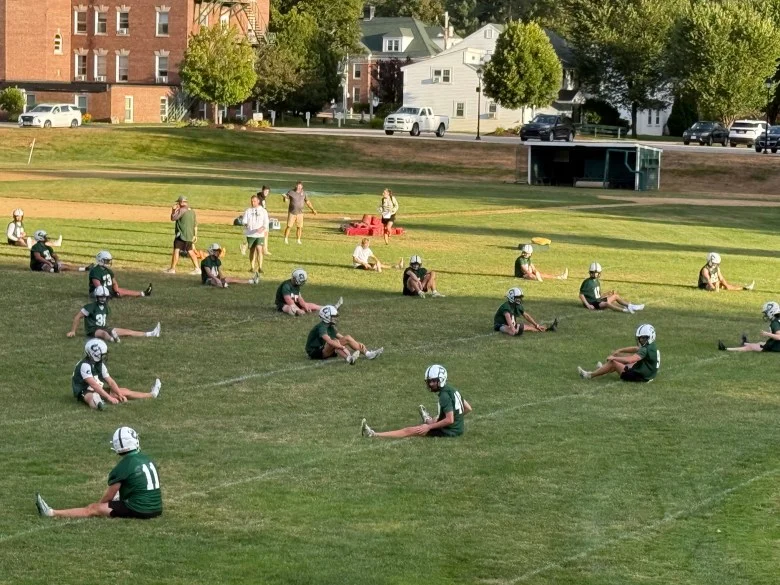
Faced with chronic funding shortfalls, schools — and students — are finding ways to improvise.
Molly McDougal, assistant athletic director for Kearsarge Regional School District in New Hampshire, laughed recounting one such workaround: a technique called TACO, short for "tarp-assisted cooling with oscillation." Her district can't afford standing cold-water immersion tubs, so coaches instead lay overheated athletes in a tarp filled with ice water to bring their body temperature down rapidly.
"It sounds, for lack of a better word, kind of sketchy," McDougal said. "But it's just as effective."
In neighboring Massachusetts, Boston public schools — unable to afford full-time athletic staff at the level of surrounding districts — began partnering with a regional hospital to bring in a team of athletic trainers. Elsewhere, a dermatology organization offers grants to help schools add shade structures, while California launched a statewide initiative to convert asphalt-covered schoolyards into shaded green spaces.
Isabella Malloy, a senior at Vista PEAK Preparatory in Aurora, Colorado, believes student athletes also need to take ownership of their own safety. Temperatures in Aurora have already shattered heat records this year, reaching 85 degrees. Malloy, who has competed in flag football, softball, and wrestling, recalled hyperventilating during one warm Saturday morning game and signaling her coach to substitute her out. He immediately began pouring water over her head.
"You have to know yourself, and if something doesn't feel right," Malloy said. "Some kids get afraid if they tell coach they're tired, he'll make you run more. It's hard to advocate for ourselves when you also don't want to seem lazy."
The safety measures come with real tradeoffs.
Even with the facilities available at Lake Buena Vista High School, LaComb said wet-bulb readings frequently prevented his football team from practicing at all. Some athletes, desperate to maximize their time on the field, resorted to blowing on the wet-bulb thermometer in hopes of triggering a falsely cool reading — or organized informal practices at nearby parks, away from trained staff and safety protocols.
"It's so hot, and the heat's increasing so much over the years," LaComb said. "We get less and less play time every year."
"It really impacts the joy that you have in the sport," he added. "You're supposed to think only of the game, but now you're just thinking about how hot it is — even when you're sitting on the bench."
Contact staff writer Neal Morton at 212-678-8247, on Signal at nealmorton.99, or via email at [email protected].
This story about heat deaths was produced by The Hechinger Report, a nonprofit, independent news organization focused on inequality and innovation in education. Sign up for the Hechinger newsletter.
The post The heat is on: As climate change threatens student athlete safety, states try to adapt appeared first on The Hechinger Report.