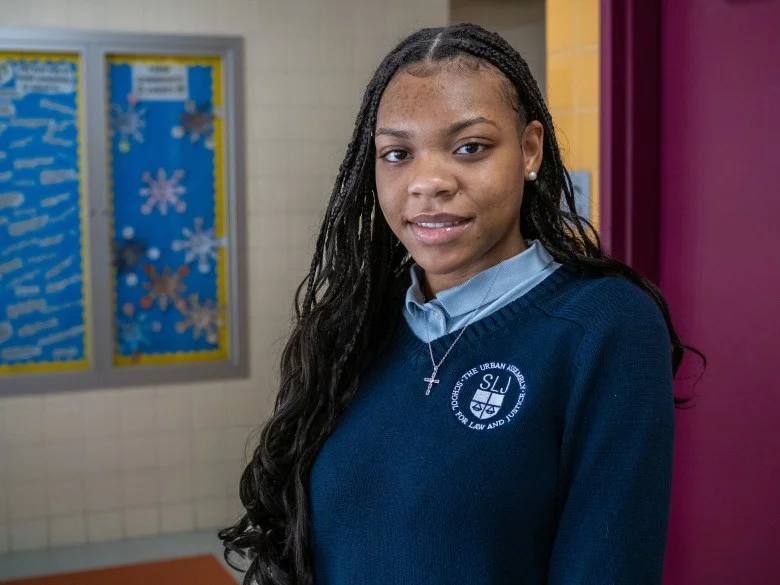
BROOKLYN, N.Y. — At 16, Khloe Watson-Barrett already has her sights set on a career in law. She also knows that the high-stakes college admissions process is fast approaching, now that she's more than halfway through her junior year.
"It's nerve-wracking," Watson-Barrett said of what she's heard about applying to college.
That anxiety is compounded for many students by a simple lack of access: school counselors are often so overwhelmed with procedural questions — which tests to take, which deadlines to hit, how to complete financial aid forms — that meaningful, one-on-one guidance can be hard to come by.
Watson-Barrett's school and many others are now beginning to pilot a new generation of technology designed to change that equation. Artificial intelligence built specifically for college counseling promises to handle routine inquiries — including outside school hours — so that counselors can focus on the guidance that actually requires a human touch.
Unlike general-purpose AI tools that scrape the open web and are susceptible to misinformation and manipulation, these purpose-built systems are trained on expert-verified content drawn from the history of real student questions. They also incorporate something many high school counselors struggle to provide: real-time labor market data — which jobs are in demand, what they pay, and what credentials they require.
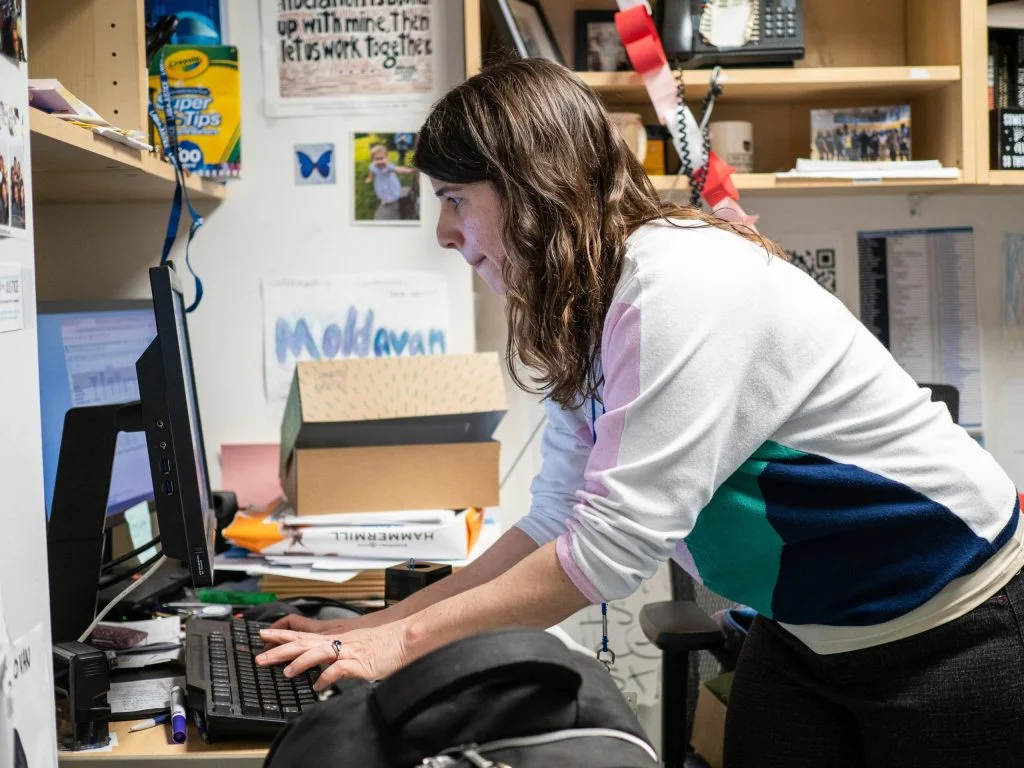
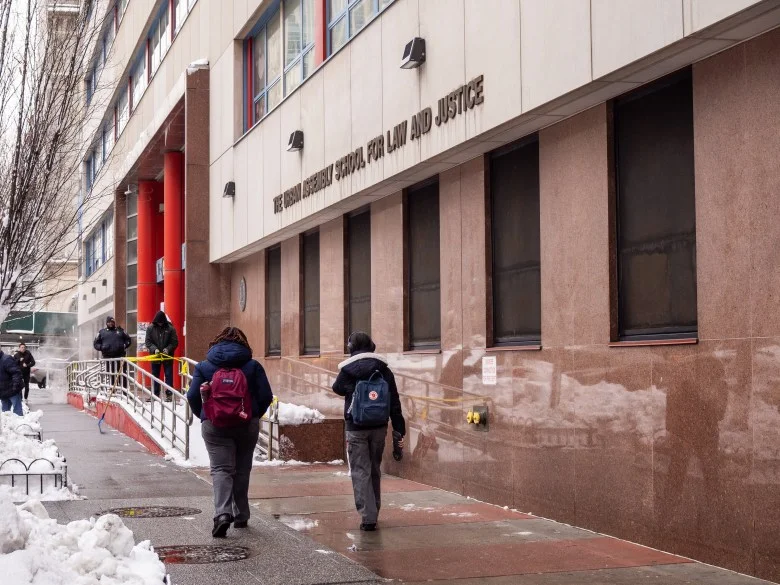
Human counselors remain indispensable for understanding a student's individual ambitions, said Diana Moldovan, director of college and career placement at the public Urban Assembly School for Law and Justice in Brooklyn, where Watson-Barrett is enrolled. "You can't replace the trust," Moldovan said. But counselors routinely get bogged down in administrative tasks — chasing students to complete essays, walking them through financial aid paperwork — that leave little room for deeper conversations. "If AI could do some of these things, that leaves more time" to talk with soon-to-be graduates about their academic, social and financial choices.
What distinguishes this emerging category of tools from the broader AI landscape, Moldovan and others note, is its intent. Unlike AI in many industries — where automation often replaces human roles — the platforms being developed for college counseling are explicitly designed to increase human interaction, not reduce it. That includes CounselorGPT, a new AI platform that Moldovan's school is set to begin piloting next year.
Related: Interested in innovations in higher education? Subscribe to our free biweekly higher education newsletter.
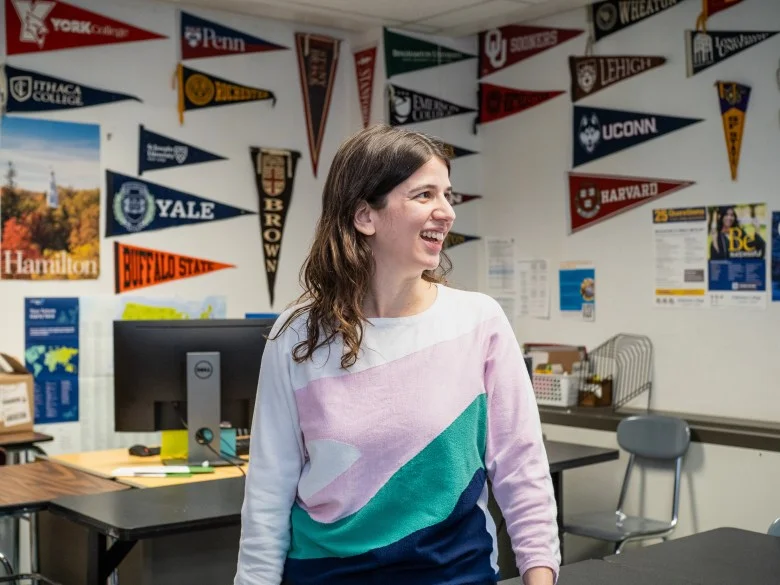
Moldovan's office — lined with college and university banners — stays busy despite a relatively favorable counselor-to-student ratio. The school has roughly 200 juniors and seniors spread across three college advisers, putting each counselor's caseload at fewer than 70 students. That's a fraction of the national average.
According to the American School Counseling Association, the national student-to-counselor ratio stands at 372:1 — and that figure masks far worse conditions in individual states. In Arizona, counselors are responsible for 570 students each; in Michigan, 565; in Minnesota, 539; and in California, 432. Nearly one in five high schools have no college counselor at all.
Even where counselors exist, they're stretched thin by competing responsibilities. The National Association for College Admission Counseling, NACAC, estimates that only about a fifth of a school counselor's time is spent directly on college admissions advising. And counselors are available only during school hours — not on evenings, weekends, holidays, or over the summer, precisely when many students are doing their most critical planning.
Purpose-built AI could address these long-standing structural gaps, said Angel Pérez, NACAC's CEO. "As the technology grows and gets stronger, counselors can outsource the basic information that students need and focus on the human aspects of these young people," he said.
The urgency is real: nearly half of students are already turning to AI independently to navigate the college application process, according to a February survey by the higher education consulting firm EAB. Students are using it to compare schools, complete applications, and prepare for standardized tests.
Related: A trend colleges might not want applicants to notice: It's becoming easier to get in
That trend alarms college counseling professionals. Most general-purpose generative AI cannot reliably filter out misinformation, they warn, and is vulnerable to manipulation by college recruiters who game search results to elevate certain institutions.
"I would not want a young person to be using these tools by themselves, because it's about asking the right questions," Pérez said. "Ask [generative] AI what college you're going to get into — you're not going to get the right answers. There still has to be the human component."
For counselors to meaningfully compete with always-available AI, they need tools of their own: purpose-built systems preloaded with accurate, expert-verified information. "It should be able to give the information [counselors] would normally give to students — how to take the SAT and fill out the FAFSA," Pérez said. "All of that can be given to students at the press of a button, so college counselors can talk about fit and match and the unique aspects of the individual student."
For now, that vision remains more promise than reality. Several competing platforms are in early or experimental stages, and widespread adoption is still a long way off.
One such tool is CounselorGPT, which has been piloted this year across 13 of the 22 public high schools operated in New York City by the nonprofit Urban Assembly. Developed and owned exclusively by Urban Assembly, the platform draws on real-time job postings analyzed by labor market data firm Lightcast to surface which careers are in demand, what they pay, what credentials they require, and how much it costs to acquire those qualifications.
That's the kind of granular, market-driven intelligence that traditional high school college counselors have rarely been equipped to offer — yet it's precisely what students need, according to David Adams, CEO of Urban Assembly, whose schools are explicitly built around workforce preparation.
Related: Colleges ease the dreaded admissions process as the supply of applicants declines
"Even when students have access to the highest-quality college counselors, they can't possibly know all the information around labor markets," Adams said. "Students are left guessing about what kind of degree leads to social and economic mobility."
The consequences of that guesswork can be severe. "They shouldn't have to go through college and struggle to get a job before they realize the low return on that credential," he said.
A second AI platform entering this space is the Expert Virtual Assistant — known as EVA — currently being developed by College Guidance Network, a private company that holds a partnership with NACAC. Rather than simply returning text answers to student questions, EVA routes users to curated videos and deeper resources on the college application process.
Jon Carson, CEO of College Guidance Network, traces the company's origins to a personal frustration: his own son, attending high school in an affluent Boston suburb, received just one hour per year with his college counselor — a professional stretched thin by a range of non-academic responsibilities as well.
"I was stunned," Carson said. "That's the quantity problem. Then we get to the quality problem, which is that the average counselor also has to be a social worker."
AI can't replace human counselors, Carson acknowledged, but it can deliver reliable basic information around the clock. EVA also logs student questions, giving counselors a running record of what their students are thinking before they even sit down together — a dynamic Carson likens to the intake form a patient completes before seeing a doctor.
"What you're trying to leverage here is that one hour that the counselor does have," he said. "And they don't have to use it answering the simplest questions."
Twenty high schools are currently piloting EVA. Mike Penney, a college and career counselor at one of them — Abby Kelley Foster Charter Public School in Worcester, Massachusetts — sees clear practical value. "It puts the ball in the students' courts in terms of doing the groundwork," he said. "Then, when I meet with them, we can have a better conversation about next steps and where to go from there."
Related: College admissions offices take on a new role: Coaxing accepted students to show up
Not every counselor is sold on the idea. While many are open to using AI to streamline their own workloads, fewer than 40 percent view it as an appropriate tool for direct student-facing services, according to a survey conducted by the American School Counselor Association and researchers at Ball State University.
"It's still in the very early stages, and I'm seeing a little hesitation," said Pérez. Some counselors fear AI could eventually be used to justify further inflating student-to-counselor ratios — or, worse, to eliminate their positions entirely.
"I don't think that's just college counselors," Pérez added. "I think that's all of us."
Students themselves present a more mixed picture. Some who have built meaningful relationships with their counselors are resistant to the technology — and tool fatigue is a real barrier. "The hardest thing is getting them to use the tools available," Penney noted. "They've never had so many, and it can be overwhelming."
There are also concerns about emotional over-reliance. EVA was originally designed with a female icon and pronouns to match its name, but developers are now switching to an owl mascot specifically to discourage students from sentimentalizing the tool.
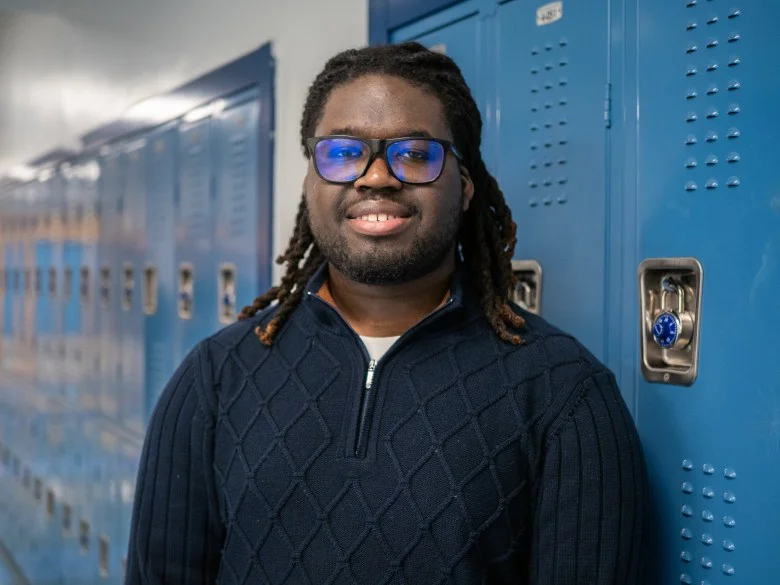
Jaheem Shaw, a senior at the Urban Assembly School for Law and Justice who is weighing offers from several universities, worked through the process with the help of human advisers — an experience he found both nerve-wracking and deeply personal, a sentiment echoed by junior Khloe Watson-Barrett.
His counselors, Shaw said, "get to know you as a person, your interests, where you want to go. There's a lot of value in asking someone who has experience in the process, on a more personal level."
They also offered something harder to quantify: encouragement. "And I don't think that's something you can get from AI," Shaw said.
Contact writer Jon Marcus at 212-678-7556, [email protected] or jpm.82 on Signal.
This story about AI in college counseling was produced by The Hechinger Report, a nonprofit, independent news organization focused on inequality and innovation in education. Sign up for our higher education newsletter.